

Knowing how to read a wine label is one of the easiest ways to choose better and enjoy every bottle more. You don’t need to be an expert or memorize regions: by understanding 4 or 5 key details, the label becomes your best ally.
At Idyllica we see it every day in the shop and at our wine tastings in Barcelona: many questions are solved simply by learning to read the label properly before buying.
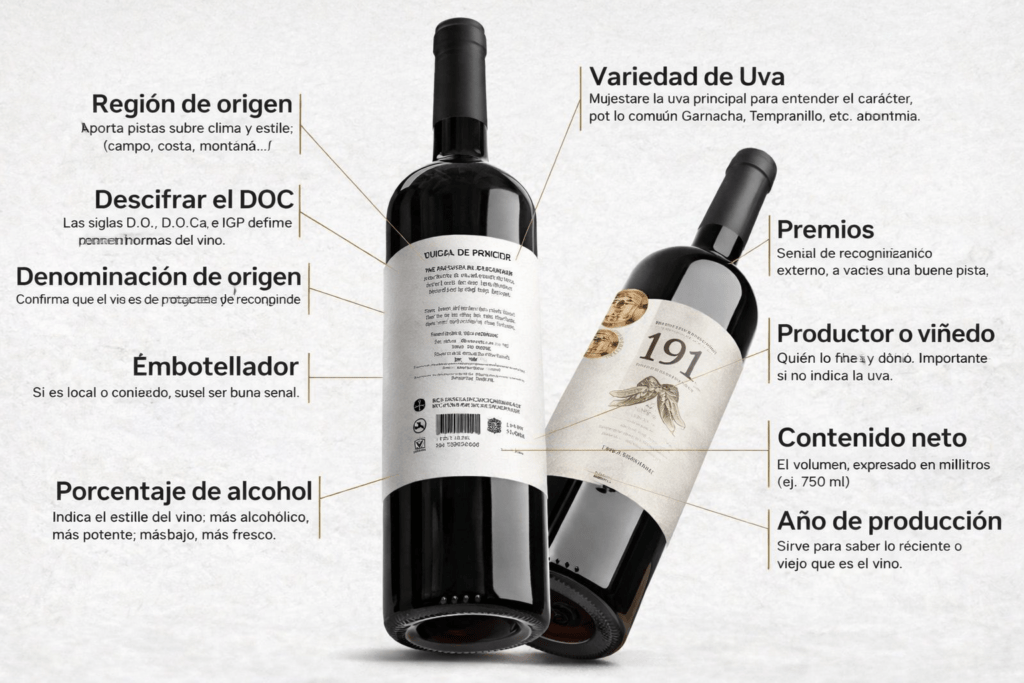
Quick answer: to read a wine label, look at the origin (D.O.), the grape or style, the vintage, the producer, and the alcohol by volume. With that, you can already tell whether a wine will suit you before opening it.
Table of contents
- What a wine label is (and what it isn’t)
- Origin and designation of origin
- Grape or style: how to interpret it
- Vintage: when it matters and when it doesn’t
- Alcohol by volume and what it says about the wine
- Producer and bottling
- Common mistakes when reading labels
- Frequently asked questions
What a wine label is (and what it isn’t)
A wine label isn’t just design. It’s a mandatory information document that gives very clear clues about the wine inside the bottle.
That said: not everything important is printed in big letters. Sometimes the most useful information is in small print… and what stands out most is just marketing.
Origin and designation of origin
Origin is one of the most reliable pieces of information on the label. It may appear as D.O., D.O.Ca., IGP or as a specific area.
- D.O. / D.O.Ca.: indicates a style and certain quality rules.
- Specific area: helps you understand climate, freshness, and ripeness.
Idyllica tip: if you like a wine from a certain area, try others from the same region even if you don’t know the producer. It’s a very reliable way to get it right.
Grape or style: how to interpret it
Some labels clearly state the grape variety (Garnacha, Tempranillo, Xarel·lo…) and others don’t. Both options are normal.
- With the grape listed: ideal if you’re just getting started.
- Without the grape listed: trust the traditional style of the region.
Over time you’ll discover you’re not only choosing grapes, but styles and sensations: fresh wines, powerful wines, lighter wines, or food-friendly wines.
Vintage: when it matters and when it doesn’t
The vintage indicates the year the grapes were harvested. It matters more for age-worthy wines than for young wines.
- Young wines: more recent vintages are usually better.
- Wines with aging: the vintage adds nuance, but it isn’t everything.
Alcohol by volume: a key clue
Alcohol by volume tells you a lot about a wine’s style:
- 11–12%: fresh, lighter wines.
- 13–14%: balance and medium body.
- 14.5% or more: intense, powerful wines.
This detail helps you choose wine for the moment: aperitif, meal, or after dinner.
Producer and bottling
Look for who makes the wine and whether it’s bottled at origin. A clear, local producer is often a good sign.
Common mistakes when reading labels
- Choosing only based on a pretty label.
- Thinking more aging is always better.
- Confusing price with personal taste.
These mistakes are very common in the shop and at tastings… and very easy to avoid.
Frequently asked questions
How do you read a wine label correctly?
Look at the origin, the designation of origin, the grape or style, the vintage, the producer, and the alcohol by volume. With these details you can choose a suitable wine without needing to taste it first.
Does the vintage matter when choosing a wine?
The vintage matters especially for age-worthy wines or wines with aging. For young wines, it’s usually best to choose more recent vintages.
Can you choose a good wine just by reading the label?
Yes. If you know how to interpret the key information on the label, you can choose with quite a high chance of success.
Learning to read a wine label is learning to choose better. And the more you practice, the more you enjoy every glass. If you want to train your eye (and your palate), our tastings are the best place to start.
